What Is Sermorelin? How Growth Hormone Peptides Work for Recovery, Sleep, and Healthy Aging
People often confuse sermorelin with synthetic human growth hormone (HGH). Here is a plain-English look at how sermorelin nudges your body’s own natural nighttime hormone pulse, why it has a built-in "safety brake," and what clinical studies actually show.

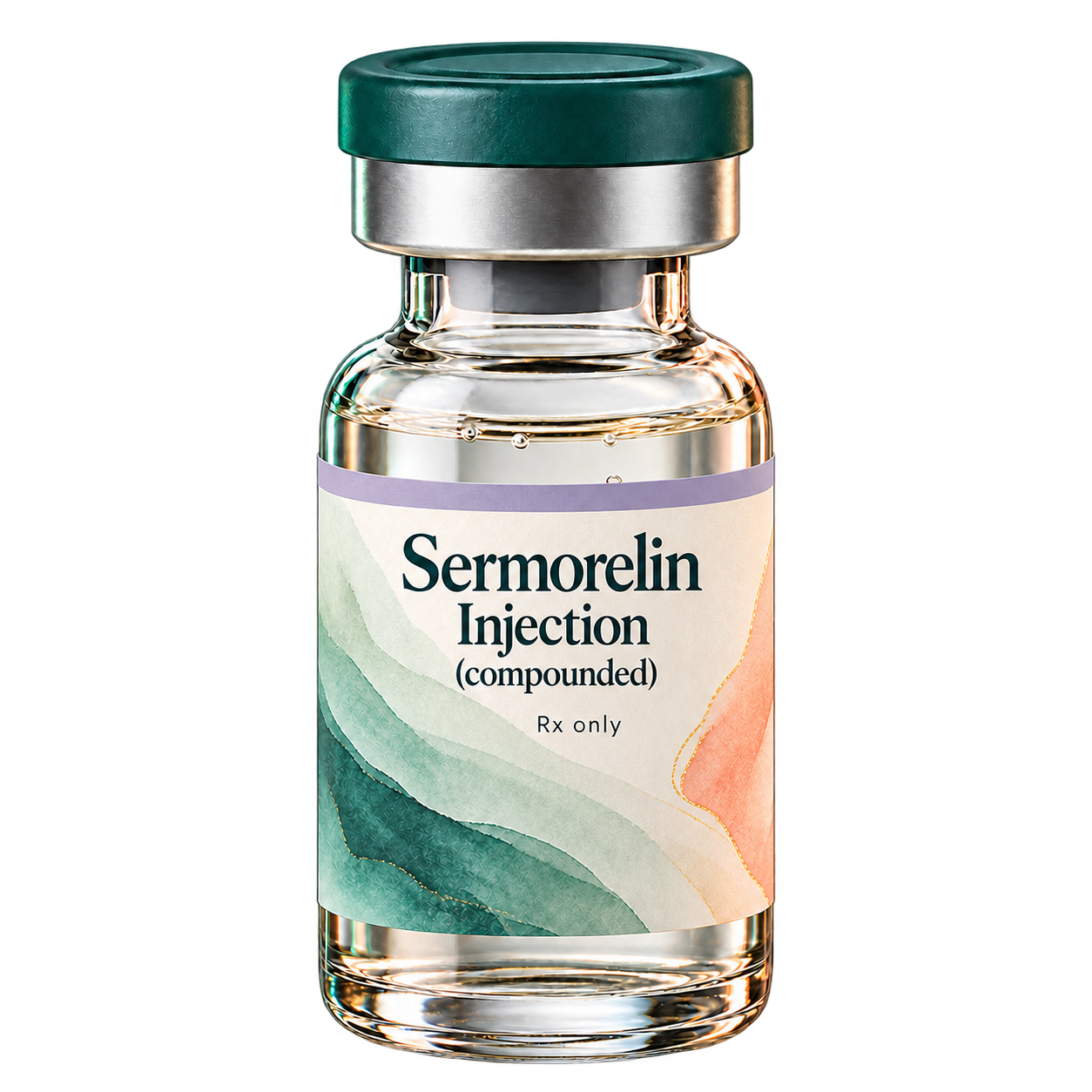 Peak Recovery Injection · Compounded Sermorelin ($249/mo)
The quick answer (if you only have 30 seconds)
- Sermorelin is NOT synthetic growth hormone (HGH): Instead of flooding your body with outside hormone, sermorelin is a tiny 29-amino-acid messenger peptide that gently tells your pituitary gland to release its own natural growth hormone.
- Why you take it right before bed: Your body naturally releases its biggest wave of growth hormone during deep sleep in the first 90 minutes of the night. Sermorelin works for about 11 to 12 minutes to amplify that natural nighttime wave.
- It keeps your body’s natural "safety brake" turned on: Because your brain still controls the thermostat (via a hormone called somatostatin), sermorelin avoids the runaway hormone spikes, joint pain, and water retention often seen with synthetic HGH.
1. Why growth hormone drops as we age (and how sermorelin works)
In our 20s, our pituitary gland releases healthy nighttime pulses of human growth hormone (hGH), which signals the liver to produce IGF-1, the hormone that helps repair muscle after workouts, maintain skin collagen, and support metabolism.
After age 30, that natural 24-hour output drops by roughly 50% every 7 to 10 years (a natural slowdown doctors call somatopause). Interestingly, studies show that an older adult’s pituitary gland still has plenty of growth hormone stored inside; it just gets weaker "wake-up signals" from the brain.
Enter sermorelin: Sermorelin is an exact copy of the first 29 amino acids of your brain’s natural growth hormone-releasing hormone (GHRH). When injected just under the skin at bedtime:
- It knocks on the pituitary’s door: It binds to GHRH receptors on your pituitary cells, telling them to release a natural pulse of your own growth hormone and replenish their internal reserves.
- Your built-in "safety brake" stays intact: When your hGH and IGF-1 levels reach a healthy physiological range, your brain releases a brake hormone (somatostatin) that tells the pituitary, "That is enough for tonight." Direct synthetic HGH injections bypass that brake completely, which is why synthetic HGH can cause fluid swelling (in up to 50% of older adults in trials), carpal tunnel syndrome, and blood sugar spikes.
2. Sermorelin vs. Synthetic HGH vs. Other Peptides
Why do licensed longevity clinicians prescribe compounded sermorelin instead of random "research peptides" sold online (like CJC-1295 or Ipamorelin)? It comes down to both natural rhythm and FDA compounding rules:
| What to compare | Sermorelin (Peak Recovery) | Synthetic HGH (Somatropin) | Other Peptides (CJC-1295 / Ipamorelin) |
|---|---|---|---|
| How it works | Gently triggers your pituitary’s own natural nightly hGH pulse | Directly replaces growth hormone from the outside (bypasses pituitary) | Triggers prolonged or ghrelin-pathway hormone release |
| How long it stays active | ~11 to 12 minutes (matches your natural bedtime pulse) | Hours of continuous high exposure | Hours to 6 to 8 days (eliminates natural wave rhythm) |
| Natural "safety brake" | Yes (body stops releasing when levels are full) | No (can cause excess hormone buildup) | Varies; long-acting versions keep receptors turned on nonstop |
| Swelling & joint-ache risk | Very low | High (swelling in up to ~50% of older adults in studies) | Higher risk of appetite spikes, cortisol shifts, or immune reactions |
| Legal 503A pharmacy compounding | Eligible for prescription compounding (previously FDA-approved as Geref and never withdrawn for safety reasons) | Restricted DEA/specialty indications only | Placed on FDA Category 2 safety-risk list (not eligible for standard 503A compounding) |
3. What do human clinical studies actually show? (The honest truth)
On social media, peptides sometimes get hyped as magic fountains of youth. At Sovi, we prefer to give you the honest, science-backed picture from controlled clinical studies in adults aged 55 to 78 (such as the trials by Corpas, Vittone, Khorram, and Steiger):
- Hormone & IGF-1 restoration: Nightly sermorelin reliably boosts nighttime growth hormone pulses and nudges IGF-1 levels back toward healthier young-adult ranges without throwing off fasting blood sugar.
- Modest, steady body-composition & skin support: Because your body’s natural safety brake stays on, sermorelin does not cause extreme bodybuilder muscle gains on its own. In a 16-week placebo-controlled trial (Khorram et al.), older men gained an average of about 2.8 lbs (1.26 kg) of lean body mass with improved insulin sensitivity, and both men and women saw measurable improvements in skin thickness and collagen. It works best when paired with regular strength training and high-protein nutrition.
- Sleep quality: Because natural growth hormone is tied to deep slow-wave sleep in the first 90 minutes of the night, taking sermorelin at bedtime aligns with your body clock. Many patients report feeling more rested, though lab sleep studies show the strongest deep-sleep boost happens in men, while some women can occasionally feel more alert if dosed too late.
4. Side effects, lab monitoring, and who should skip it
Sermorelin is generally very well tolerated. The most common side effects are:
- Mild redness or itching at the injection spot (in about 1 in 5 people, usually fading within a few hours).
- Brief facial warmth or flushing right after injection (in 2% to 5% of doses, fading quickly as the peptide clears in 12 minutes).
What your clinician checks: To keep therapy safe and effective, clinicians recommend checking your IGF-1 levels, thyroid panel (TSH and Free T4), and fasting blood sugar / A1c periodically so your dose stays right in your healthy age-adjusted sweet spot.
Who should NOT take sermorelin: Because growth hormone and IGF-1 encourage cells to grow, sermorelin should never be used if you have an active cancer or tumor, if you are pregnant or breastfeeding, or if you are a competitive athlete subject to WADA anti-doping testing (where all growth-hormone peptides are banned).
5. Bottom line: is Peak Recovery (Sermorelin) right for you?
- Sermorelin ($249/month at Sovi) is a great fit if: You are in your 30s, 40s, 50s, or beyond, you already lift weights or exercise regularly, and you want a clinician-guided way to support your body’s natural nighttime recovery, lean muscle maintenance, and skin vitality without the risks of synthetic HGH.
- If your #1 goal is major weight loss (20 to 50+ lbs): Sermorelin is not a primary weight-loss medication. You will get much stronger weight-reduction results starting with a weekly GLP-1 or GIP/GLP-1 plan like Tirzepatide or Semaglutide.
See if Peak Recovery (Sermorelin) fits your goals
Complete our online intake to share your health history and recovery goals with a licensed clinician.
* Educational information only; this guide summarizes published endocrine research and does not constitute individual medical advice or a guarantee of results. Prescription required. Compounded sermorelin is not FDA-approved; FDA does not review compounded medications for safety, effectiveness, or quality before marketing. While a commercial sermorelin product (Geref) was previously FDA-approved for pediatric growth hormone deficiency and diagnostic testing before being discontinued for commercial reasons, use of compounded sermorelin for adult wellness, recovery, or body composition is off-label and has not been proven to reverse aging or extend lifespan. Sovi does not manufacture compounded medications. Product images are illustrative, and actual dispensed packaging and labeling may differ.